• ABOUT
    arrow_drop_down
    • Overview
    • Team
    • Contact Us
  • Training
    arrow_drop_down
    • Overview
    • Search All
      arrow_drop_down
      • Forthcoming
      • Past
      • Search by Levels
        arrow_drop_down
        • Diploma
        • Programmes
        • Courses
      • Search By Subject
        arrow_drop_down
        • Sustainability Masterclass
          arrow_drop_down
          • Economy
          • Sustainability
        • Public Policy
          arrow_drop_down
          • Public Policy
          • Education
          • Higher Education
          • Health
            arrow_drop_down
            • Covid-19
          • Women
          • Youth
            arrow_drop_down
            • Security
        • Digital Transformation
          arrow_drop_down
          • Artificial Intelligence
          • Data Science
          • Digital Transformation
          • Innovation
          • Knowledge Management
          • Technology Transfer
        • Business & Management
          arrow_drop_down
          • Entrepreneurship
          • HRM
          • Leadership
          • Management
          • Performance Improvement
          • Investment
    • Workshops
  • Teaching
    arrow_drop_down
    • Framework
    • Universities
      arrow_drop_down
      • SDGs Universities
      • African Universities
        arrow_drop_down
        • Sudan Universities
      • Arab Universities
        arrow_drop_down
        • Gulf Universities
          arrow_drop_down
          • Qatar Universities
          • Bahrain Universities
          • Kuwait Universities
          • Emirates Universities
          • Oman Universities
          • KSA Universities
      • Islamic Universities
      • Women Universities
    • Courses
      arrow_drop_down
      • PhD/DBA
      • MSc/MBA
      • PG Diploma
      • PG Certificate
  • Research
    arrow_drop_down
    • Research Tracks
    • Publishing
  • Consultancy
    arrow_drop_down
    • Smart KM
  • Experts
    arrow_drop_down
    • Overview
    • Global Who’sWho
      arrow_drop_down
      • Interactive Map
    • Women Who’sWho
    • Diaspora Who’sWho
    • Arab Who’sWho
      arrow_drop_down
      • Interactive Map
    • Africa Who’sWho
      arrow_drop_down
      • Interactive Map
    • Sudan Who’sWho
      arrow_drop_down
      • Interactive Map
      • Sudan Doctors
        arrow_drop_down
        • Interactive Map
  • Partnerships
  • Latest News
  • Resources
    arrow_drop_down
    • Digital Library
    • Book Store
  • Media
    arrow_drop_down
    • Videos
    • Gallery
  • FAQs
Sign in or Register

PGDM

  • Send an email
  • Other Courses
  • Overview
  • Support
  • Learning Outcome
  • Programme
  • Assessment
  • Resources
  • Target Participants
  • Faculty
  • Registration
  • Gallery
  • prev
  • next
  • Get directions
  • Other Courses
  • Share
  • prev
  • next
Overview

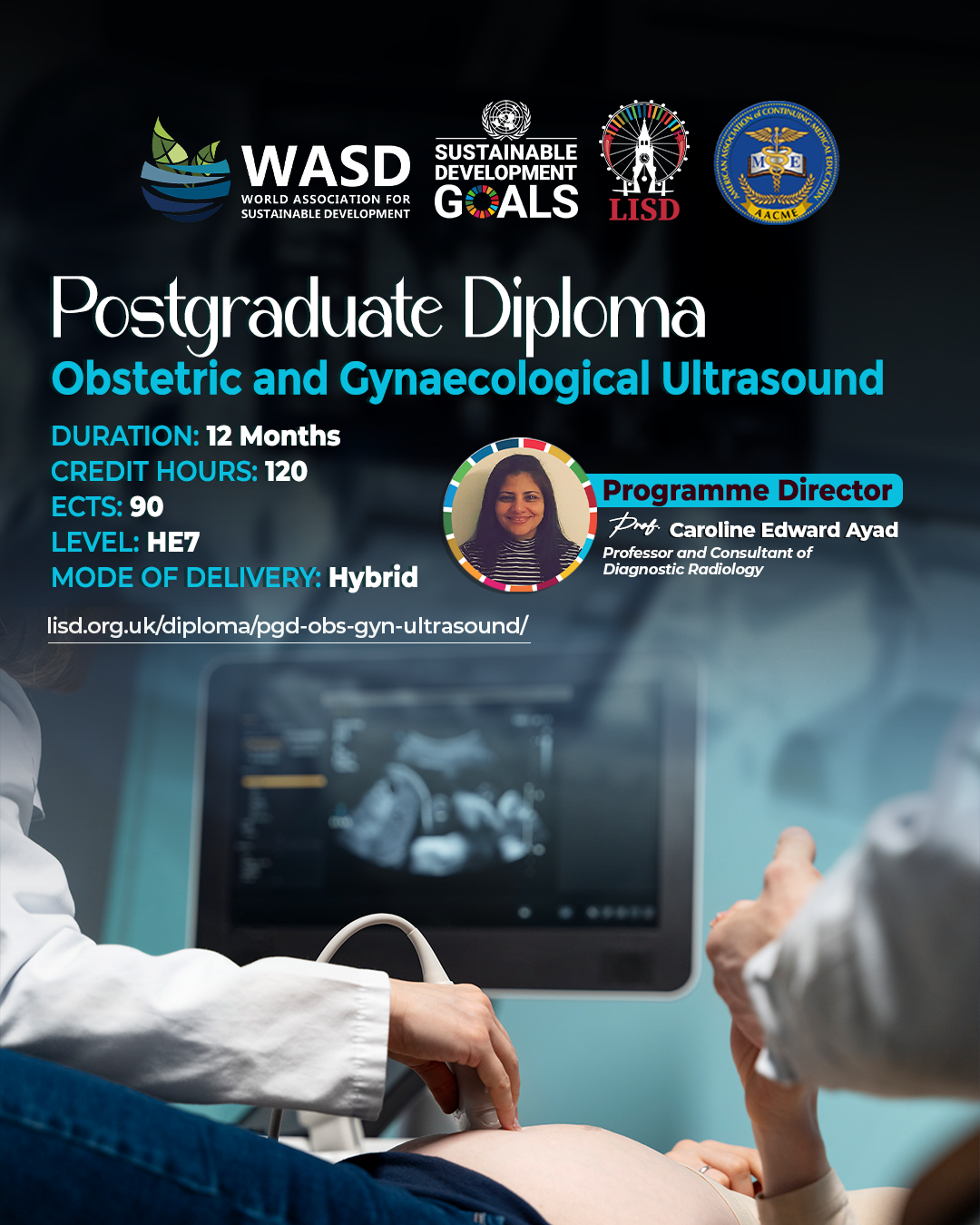
Postgraduate Diploma Obstetric and Gynaecological Ultrasound
Certificate from London Institute of Sustainable Development (LISD) and the American Association of Continuing Medical Education (AACME)

Duration: 12 Months
Credit Hours: 120
ECTS: 90
Level: HE7
Mode of Delivery:
Theory - Hybrid (Online/Onsite on different locations across the world)
Practical - Face-to-Face (Onsite on different locations in your country - medical schools, hospitals and clincs)

Overview

The Postgraduate Diploma in Obstetric and Gynaecological Ultrasound is a unique advanced program, designed to address needs for in-depth training in ultrasound imaging specific to obstetric and gynaecological care, to equip candidates with the core knowledge and skills in using ultrasound technology during pregnancy and interpreting fetal ultrasound images and gynaecological conditions, as well as Ultrasound images of female reproductive pathologies.  This diploma enhances clinical expertise and diagnostic accuracy in ultrasound imaging.

It is based on the best international and regional practice in similar programs. It takes into consideration the requirements to develop and update Obstetric and Gynaecological Ultrasound skills in the discipline. The programme is a modular structure comprising several modules and a comprehensive assessment of knowledge, skills and professionalism.

Vision

All medical diagnostic ultrasound professions in the discipline combine close patient contact and good communication skills along with the use of technology, to maximise the results for the patient and provide high quality patient care.

Mission

  1. To provide a high standard of teaching and training to the candidates.
  2. To introduce and implement the professional attitude and medical ethics.
  3. To deliver clinical excellence and quality service to medical sector and to the community.

Aims and Objectives

  1. To enhance professional practice in medical ultrasound
  2. To enhance critical, analytical, professional, research and communication skills and promote the ability to relate these skills to ultrasound clinical practice
  3. To prepare candidates with the skills required to develop professional roles to advanced and consultant level in the future level
  4. To provide highly knowledgeable and well-trained physicians and technologists in the fields of Obstetric and Gynaecological ultrasound scans.
  5. To provide the graduate student with enough computational skills to meet the cutting-edge technology in Obstetric and Gynaecological Ultrasound scans.
  6. To motivate and encourage the collaboration with others within medical imaging in specific and related medical discipline to promote standards of excellence in the medical imaging sciences.

Strategy Outline

The concept of this programme is an educational process which is acknowledged and proven to be highly effective toward the demand of skilled graduate. The curriculum maintains basic core courses which are necessary to employ in the future plans. This scheme aims to give a comprehensive view in Obstetrics and Gynaecology Ultrasound and a focused on the specific selected tracks .The following courses describe the vision to implement PGD in Obstetrical and Gynaecological Ultrasound.

 A One of-a-Kind Initiative

At LISD, the PGDM offers a transformative learning experience that unites innovation, mentorship, and global engagement. Aligned with the United Nations 2030 Agenda and the Sustainable Development Goals (SDGs), the programme empowers students to tackle real-world healthcare challenges from advancing health equity and digital innovation to improving system resilience and policy effectiveness.


Related Sustainable Development Goals
  • SDG9
  • SDG4
  • SDG8
  • SDG6
  • SDG5
  • SDG3
Related Courses
  • Post Graduate
  • MSc/MBA
  • PG Diploma
  • Professional
  • Women
  • Health
Location

London Institute of Sustainable Development, England EC1M 6BE, United Kingdom
Get Directions
Country/Regions
  • Europe
  • UK
Social Networks
  • Facebook
  • Twitter
  • YouTube
  • LinkedIn
  • Website

Facilitators

Professor Caroline Edward Ayad
Professor of Diagnostic Radiology  and consultant since 2006 and sonologist since 2016  at College of Medical Radiological Science, Sudan University of Science and Technology. Long experience of training students on all of conventional radiological science (Conventional X-rays, CT, MRI as well as ultrasound including obstetrics and gynecology, MSK and Small parts with Professional/Clinical Practice in Diagnostic Radiological Technology field. Expertise in curriculum development, strategic planning and objective setting, staff recruitments/training and goal achievement. Having knowledge in, teaching and administration with meticulous, thorough and organized work attitude allowed to succeed in working for students’ education as well having the Experience in Academic Program Development, Educational Leadership, Innovative Teaching Techniques, Student Counseling and Positive Student Relationships and Students Administration and Registration. Regarding the research field having experience in Journal Publication Procedures Research Analyses and data interpretation. Research interests include Radio- anatomical studies in medical imaging, obstetrics and gynecology, musculoskeletal and small parts ultrasonography, Computerized Tomography and Magnetic Resonance Imaging, with publications of (more than 100) research papers in International Scientific journals as well as 6 scientific medical books. Member in many Academic and scientific committees (Curriculum design, examinations and Quality management and accreditation) inside and outside the university as well a member of international society of obstetrics and Gynecology (South Africa), member of American Institute of Ultrasound In Medicine (AIUM) (USA), member of British Medical Ultrasound Society, London (UK), member of British Radiology Association .Britain- London (UK). Acts as assistant editor and editor of many scientific journals as well as reviewer of articles for national and international scientific journals.

Related Sustainable Development Goals
  • SDG9
  • SDG4
  • SDG8
  • SDG6
  • SDG5
  • SDG3
Related Courses
  • Post Graduate
  • MSc/MBA
  • PG Diploma
  • Professional
  • Women
  • Health
What will you learn

Programme Learning Outcomes

After completion, the candidate should:

  1. Know how to perform detailed obstetric and gynaecological ultrasound scans with precision.
  2. Have in-depth knowledge of fetal anatomy, growth patterns, and how to detect abnormalities.
  3. Know techniques for evaluating maternal health conditions using ultrasound.
  4. Know how to assess and diagnose complex gynaecological conditions with ultrasound.
  5. Have Skills to analyse and interpret challenging ultrasound images for accurate diagnosis.
  6. Enhance the ability to use ultrasound findings to make informed clinical decisions in obstetrics and gynaecology.
  7. Interpret images done by TVS and TA ultrasound examination.
  8. Perform complete ultrasound examinations in all trimesters of pregnancy.
  9. Write comprehensive obstetric and gynaecological ultrasound reports.
  10. Identify fetal dysmorphology and what are the significance of their presence.
  11. Determine how and when to use colour Doppler, 3D, 4D in obstetrics and gynaecology.

Strategy Outline

The concept of this PGDM is an educational programme which is acknowledged and proven to be highly effective towards the demand of skilled graduate. The curriculum maintains basic core courses which are necessary to employ in the future plans. This scheme (6 modules) aims to give a comprehensive view in Obstetrics and Gynaecology Ultrasound with a focus on selected specific tracks.  

Module One: Ultrasound Physics and Instrumentation (Knobology) [7 Credits]

This module provides students with an introduction of sonographic physics and instrumentation information including the principles of ultrasound, type of waves, waves equations, transducer construction, Knobology, pulse echo instruments, Doppler, display modes, real-time scanners, image storage and display, recording ultrasound contrast tissue images, tissue harmonic imaging features and artifacts, quality assurance and electrical and mechanical hazards and safety.

Module Two: Ethics and Counseling [4 Credits]

This Module enables the student to have proper knowledge of medical ethics which are an integral part of patient handling, different important points in patient counselling are also to be taught.

Module Three: Clinical Practice and Professional Skills in Ultrasound [24 Credit Hours]

This module aims to critically evaluate a range of evidence, techniques and protocols relevant to ultrasound clinical practice in obstetrics and gynaecology, and make informed decisions about its quality and appropriateness. To identify, evaluate and solve problems relating to clinical ultrasound practice. Synthesise the knowledge and expertise related to the area of practice, competently interpret and report the appropriate ultrasound clinical and technical procedures. Demonstrate effective verbal and non-verbal communication skills and teamwork skills. This module is the essential course within the PGDM in obstetrics and gynaecology (Ultrasound) programme.

Module Four: Gynaecological Ultrasound [25 Credits]

The module introduces the student the general principles of Gynaecological ultrasound after teaching physics and instrumentation, and sonographic techniques. This module will enable the practitioner to competently and safely perform, interpret, communicate, manage and critically evaluate the expected and abnormal ultrasound examination in the field of ultrasound imaging of the female pelvis, normal pelvic anatomy and physiology as well as the sonographic techniques. This module will also improve theoretical and practical Knowledge of the advances and new techniques in Gynaecological ultrasound. Interventional procedures like aspiration, biopsy and saline infusion sonohystorography, acquired abnormalities of the endometrium, post-menopausal ultrasound, pediatric Gynaecological ultrasound, extra-pelvic pathology associated with gynaecology.

Module Five: Obstetrical Ultrasound [40 Credit Hours]

This module consist of 4 basic compartments. It introduces the student to the general principles of obstetrical ultrasound including fetal scanning, discuss fetal anatomy, physiology and normal Sonographic appearance in First, second and third trimesters scanning with ultrasound as well as the fetal anomalies. Discuss Ectopic pregnancy, trophoblastic diseases. It gives the candidates an understanding of professional responsibility and the ability to communicate effectively, the ability to function on multidisciplinary teams and understanding knowledge, practice and fetal sonographic scanning procedures. As well, this module will assess the causes of first trimester failure, diagnose and perform sonographic differential diagnosis of abortions in first trimester. This module will enable the practitioner to competently and safely perform, interpret, communicate, manage and critically evaluate the expected and abnormal ultrasound examination in the field of ultrasound imaging of the female pelvis, normal pelvic anatomy and physiology as well as the sonographic techniques. This module also includes the procedures in the second and third trimester ultrasound which enables the student to relate the development and wellbeing of the fetus, assess the role of colour Doppler in fetal ultrasound, discuss the basic terminologies, sonography of fetus to assess its proper growth at intervals as well; assessment of the twin or multiple pregnancy and to evaluate its complications in 2nd and 3rd trimesters. Discuss fetal biometry, multiple gestation, biophysical profile, fetal anatomy, fetal echocardiography, fetal anomalies, and fetal hazard. The Module also acquire the skills to perform differential diagnosis of fetal anomalies and critically evaluate the expected and abnormal ultrasound examination, evaluate the fetal head, fetal face, spine, abdomen, chest, heart, neck, the genitourinary tract, urinary tract anomalies, the fetal abdominal wall, fetal hydrops and congenital infections, fetal skeleton and chromosomal abnormalities, Doppler ultrasound for fetus as well as fetal echocardiography in 2nd and 3rd trimesters.

Module Six: Research Methodology, Biostatistics and Capstone Project/Dissertation  [20 Credit Hours]

This module introduces research methodology and statistics and the different steps and essentials of research are included. It formulates research problems into testable aims. Assesses different data collection methods. Chooses different sampling techniques as well as descriptive techniques for different types of design. Performs statistical computation using SPSS. Assess the ethical and practical constraints on clinical studies. Discusses the implications of research for effective clinical practice. It gives the students the ability to function on multidisciplinary teams using their knowledge of team (doctors and technicians) dynamics, communication as well as understanding knowledge, practice and procedures and discipline contexts in which Diagnostic Ultrasound Research must function, working knowledge of Radiological tools and practical methodologies. Students will be able to combine basics with their knowledge of practical procedures and modern Radiological tools to identify, and solve the Diagnostic radiology and Ultrasound examination problems. The Capstone Project for the Sonographic Imaging demonstrates applied knowledge, critical thinking, and strategic insight within specific areas. Improves theoretical and practical Knowledge of the anatomy, physiology, pathologies and sonographic techniques are important including knobology for Obstetrical and Gynaecological ultrasound. The course contents of this course comprise of data collection, preparation and then submission of dissertation.

Programme Structure

Support for Student Learning

  • Academic Support: Tutorials, workshops, and one-on-one guidance help students develop subject knowledge, research skills, and assessment strategies.
  • Technical Support: Access to digital platforms, software, and resources supports learning, data analysis, and project development.
  • Personal and Professional Development: Career services, mentoring, and skills workshops enhance employability, leadership, and professional growth.
  • Inclusive Learning Environment: Support services are provided for diverse learning needs, including study skills, wellbeing, and accessibility accommodations.
  • Feedback & Continuous Improvement: Regular, constructive feedback on assessments fosters reflective learning and academic progression.

Programme Structure

The programme requires the successful completion of 120 credits at HE7, including a Capstone Project, for the award of the PGDM. It prepares professionals to lead effectively in today’s complex and evolving healthcare landscape, combining rigorous academic study with practical application, interdisciplinary learning, and a global perspective on sustainable health systems.

Component Credits Hours
Core Modules 35
Specialisation/Clinical Modules 65
Research Methods, Biostatistics and Capstone Dissertation/Dissertation 20
Total Hours 120
Core Modules Credit Hours
Ultrasound Physics and Instrumentation (Knobology) 7
Ethics and Counselling in Medical Ultrasound 4
Clinical Practice and Professional Skills in Ultrasound 24
Total 35


Specialisation/Clinical Module Credit Hours
Gynaecological Ultrasound 25
Obstetrical Ultrasound 40
Total 65
Capstone Project 15
Credit
Hours

Module One: Ultrasound Physics and Instrumentation (Knobology)

  1. Units
  2. Transducers
  3. Pulse Echo Instruments
  4. Quality Assurance
  5. Bio effects and safety

Module Two: Ethics and Counseling

  1. Medical ethics
  2. Applied ethics (related to ultrasound field)
  3. Aims of counseling
  4. Types of counseling
  5. Methods of counseling
  6. Results and effect of counseling

Module Three: Clinical Practice and Professional Skills in Ultrasound

  1. Skill (1) Disciplinary Knowledge and Practice in different cases in obstetrics (in all trimesters) and gynaecology (Normal and abnormal cases).
  2. Skill (2) Critical Thinking.
  3. Skill (3) Solution Seeking.
  4. Skill (4) Communication.
  5. Skill (5) Independence and Truthfulness.
  6. Skill (6) Responsibilities.

Module Four: Gynaecological Ultrasound

  1. Introduction About: Equipment Fundamentals, Image Optimisation, Sonogram Interpretation, Ultrasound Artifacts, Doppler Studies, Ultrasound Bio effects and Safety.
  2. Scanning Techniques for Gyne. Studies Advantages of TAS And TVS, Transperineal sonography, trans rectal sonography, Contraindications of TAS and EVS.
  3. The Uterus, the Adnexa and Fallopian Tubes.
  4. Reproductive Physiology.
  5. Ovarian Enlargement/Masses.
  6. Intrauterine Contraceptive Devices.
  7. Congenital Anomalies of the Uterus, Vagina, Uterine, Corpus, Cervix Vagina, Endometrium, Sonographic Features, Post-Menopausal Ultrasound.
  8. Extra-Pelvic pathology associated with Gynaecology.
  9. Acquired Abnormalities of the Endometrium.
  10. Post-Menopausal Ultrasound.
  11. Paediatric Gynaecological Ultrasound.

Module Five: Obstetrical Ultrasound

  1. Sonography of Early Pregnancy Early Development, Normal Sonographic Appearance of Early Pregnancy, Early Pregnancy Failure, Ectopic Pregnancy.
  2. Gestational Trophoblastic Disease Pelvic Masses Associated With Pregnancy ,Uterine Entrapment Syndrome.
  3. Fetal Age and Fetal Growth Disorder.
  4. Fetal Maturity, Multiple Pregnancy, Prenatal Diagnosis.
  5. Fetal Assessment, Maternal Disorders Complicating Pregnancy the Cervix.
  6. The Fetal Membranes, Amniotic Fluid, the Placenta, the Umbilical Cord.
  7. Ultra sound evaluation of the fetal head, face, spine, chest, heart, neck abdomen, fetal skeleton, fetal abdominal wall, ultra sound evaluation of fetal posture, fetal demise.
  8. The Genitourinary Tract.
  9. Urinary Tract Abnormalities.
  10. Ultrasound Evaluation of Fetal Hydrops And Congenital Infections Chromosomal Abnormalities.
  11. Ultrasound in the Evaluation of Early Pregnancy, Early Development.
  12. Normal Sonographic Appearance of Early Pregnancy.
  13. Pelvic Masses Associated With Pregnancy.
  14. Uterine Entrapment Syndrome.
  15. Fetal Biometry.
  16. Multiple Gestation.
  17. IUGR.
  18. Biophysical Profile.
  19. Fetal Anatomy, fetal anomalies, fetal hydrops and congenital infections fetal skeleton chromosomal abnormalities.
  20. Fetal Echocardiography.
  21. Fetal hazards, Doppler ultrasound for fetus.

Module Six: Research Methodology, Biostatistics and Capstone Project/Dissertation

  1. Types of research.
  2. Selecting a topic for dissertation.
  3. Proposal preparation and Development.
  4. Statistical analysis Methods.
  5. Preparing Data collection sheet.
  6. Literature Review.
  7. Methodology Design, Data Collection and Analysis.
  8. Findings and Discussion.
  9. Conclusions and Recommendations.
  10. Publication and Knowledge Dissemination (if possible).

Practical Duration within the Modules

Modules Months
1 2 3 4 5 6 7 8 9 10 11 12
Ultrasound Physics and Instrumentation (Knobology) ✓ ✓
Ethics and Counselling in Medical Ultrasound ✓ ✓
Class Activities / Presentations / Seminars / Discussions ✓
Gynaecological Ultrasound ✓ ✓ ✓
Obstetrical Ultrasound ✓ ✓ ✓ ✓ ✓
Class Activities / Directed Studies ✓
Research Methods, Biostatistics and Capstone / Dissertation ✓ ✓ ✓
Clinical Practice and Professional Skills in Ultrasound ✓ ✓ ✓ ✓
Assessment

Assessment Strategy

The programme employs a diverse and integrated assessment strategy designed to evaluate knowledge, cognitive skills, practical competencies, and professional development. Assessment methods include:

  • Written assignments, essays, and research reports demonstrating critical analysis and subject mastery.
  • Project work, case studies, and capstone or applied research projects assessing practical problem-solving and application of theory.
  • Examinations and in-class tests to evaluate understanding of core concepts and analytical skills.
  • Presentations, portfolios, and reflective reports to assess communication, professional, and transferable skills.
  • Group and individual work to evaluate teamwork, leadership, and collaborative capabilities.

Assessment Regulations

  1. Assessments are conducted in accordance with institutional policies, ensuring fairness, transparency, and academic integrity.
  2. A combination of formative and summative assessments supports learning while providing opportunities for feedback and improvement.
  3. Late submission, plagiarism, and academic misconduct are managed according to formal procedures and may impact progression or classification.
  4. Students must meet minimum performance requirements across modules to achieve the overall award.
  5. In order to pass the scheduled program, candidates should complete successfully the pass mark for each module which is 50%.
  6. If the candidate fails; the following will be applied:
    • Resit: candidate will be offered one resit attempt.
    • If candidate is successful in the resit, he/she will be awarded the credit for that module.
    • If candidate does not meet the pass requirements for a module and does not complete the resit by the date specified he/she will not progress and the candidate will withdrawn from the programme.

Grade Bands and Classifications

Postgraduate Certificate: To complete the Postgraduate Certificate, candidate must successfully complete a total of 60 credits, including the two core modules (Ultrasound Physics and Clinical practice and Professional Skills in Ultrasound) and at least one clinical module.

Postgraduate Diploma: To complete the Postgraduate Diploma, candidate must successfully complete a total of 120 credits, including the core modules and clinical modules.

Final grades are awarded based on aggregated performance across assessments, using a percentage system at LISD.

LISD Grading System

Classification Percentage Range UK Grade GPA (approx.) Description
First Class Honours (1st) 70–100% A 4.0 Excellent/Outstanding
Upper Second Class Honours (2:1) 60–69% B+ / A– 3.3–3.7 Very Good
Lower Second Class Honours (2:2) 50–59% B / B– 2.7–3.0 Good
Third Class Honours (3rd) 40–49% C 2.0–2.3 Satisfactory
Fail Below 40% F 0.0–1.9 Fail/Unsatisfactory

Professor Caroline Edward Ayad
Professor of Diagnostic Radiology  and Consultant since 2006 and Sonologist since 2016. Long experience of training students on all of conventional radiological science (Conventional X-rays, CT, MRI as well as ultrasound including obstetrics and gynaecology, MSK and Small parts with Professional/Clinical Practice in Diagnostic Radiological Technology field. Expertise in curriculum development, strategic planning and objective setting, staff recruitments/training and goal achievement. Having knowledge in teaching and administration with meticulous, thorough and organized work attitude allowed to succeed in working for students’ education as well having the Experience in Academic Programme Development, Educational Leadership, Innovative Teaching Techniques, Student Counseling and Positive Student Relationships and Students Administration and Registration. Regarding the research field having experience in Journal Publication Procedures Research Analyses and data interpretation. Research interests include Radio- anatomical studies in medical imaging, obstetrics and gynaecology, musculoskeletal and small parts ultrasonography, Computerised Tomography and Magnetic Resonance Imaging, with publications of (more than 100) research papers in International Scientific journals as well as 6 scientific medical books. Member in many Academic and scientific committees (Curriculum design, examinations and Quality management and accreditation) inside and outside the university as well a member of international society of obstetrics and Gynaecology (South Africa), member of American Institute of Ultrasound In Medicine (AIUM) (USA), member of British Medical Ultrasound Society, London (UK), member of British Radiology Association. Britain- London (UK). Acts as assistant editor and editor of many scientific journals as well as reviewer of articles for national and international scientific journals.

🚀 View Past Participants
Target Participants

Radiologists, Gynaecologists and Obstetricians, Fetal medicine physicians, Technologists.

Contact Us
To register/enquire about this course and all our various comprehensive list of courses and workshops and if you have any question and/or if you would like to request a training workshop/program not listed in our portfolio please contact our Academic Director Professor Arshi Naim at: arshi@wasd.org.uk with a copy to admin@wasd.org.uk.

London Institute of Sustainable Development, England EC1M 6BE, United Kingdom

Get Directions
Registration and Fees

Included in the course fee, the following learning materials will be provided:

  1. Admission to all sessions.
  2. All overhead slides (PDF).
  3. Case studies (print and video).
  4. Full access to WASD Sustainability Library including all volumes of World Sustainable Development Outlook book series.
  5. Certificate of completion.

You May Also Be Interested In

Artificial Intelligence and Knowledge Management for Effective Leaders

Artificial Intelligence and Knowledge Management for Effective Leaders 18 Hours Course (Face to Face and…
  • Phone Number
  • SDG4
  • +3

Female Pelvic Medicine and Reconstructive Surgery (UROGYNAECOLOGY)

Female Pelvic Medicine and Reconstructive Surgery (UROGYNAECOLOGY)      REGISTER 48 Hours Course Friday…
  • Phone Number
  • SDG4
  • +4

Digital Transformation and Sustainable Development for Future Women Leaders

18 July 2023 This two-day course will be facilitated by world renowned experts in Digital Transformation…
  • Phone Number
  • SDG4
  • +2

The London Institute of Sustainable Development (LISD), founded under the auspices of the World Association for Sustainable Development (WASD), is a global centre committed to advancing the United Nations 2030 Agenda and its 17 Sustainable Development Goals (SDGs) through higher education, research, training, and consultancy.

Facebook-f Youtube Twitter Linkedin Flickr

Quick Links

  • About LISD
  • Gallery
  • Teams
  • Contact Us
  • Book Store

EXPERTS

  • Global Who’sWho
  • Women Who’sWho
  • Diaspora Who’sWho
  • Arab Who’sWho
  • Africa Who’sWho
  • Sudan Who’sWho

Get in touch

© LISD

All rights reserved

Cart

  • Facebook
  • Twitter
  • WhatsApp
  • Telegram
  • LinkedIn
  • Tumblr
  • VKontakte
  • Mail
  • Copy link