• ABOUT
    arrow_drop_down
    • Overview
    • Team
    • Contact Us
  • Training
    arrow_drop_down
    • Overview
    • Search All
      arrow_drop_down
      • Forthcoming
      • Past
      • Search by Levels
        arrow_drop_down
        • Diploma
        • Programmes
        • Courses
      • Search By Subject
        arrow_drop_down
        • Sustainability Masterclass
          arrow_drop_down
          • Economy
          • Sustainability
        • Public Policy
          arrow_drop_down
          • Public Policy
          • Education
          • Higher Education
          • Health
            arrow_drop_down
            • Covid-19
          • Women
          • Youth
            arrow_drop_down
            • Security
        • Digital Transformation
          arrow_drop_down
          • Artificial Intelligence
          • Data Science
          • Digital Transformation
          • Innovation
          • Knowledge Management
          • Technology Transfer
        • Business & Management
          arrow_drop_down
          • Entrepreneurship
          • HRM
          • Leadership
          • Management
          • Performance Improvement
          • Investment
    • Workshops
  • Teaching
    arrow_drop_down
    • Framework
    • Universities
      arrow_drop_down
      • SDGs Universities
      • African Universities
        arrow_drop_down
        • Sudan Universities
      • Arab Universities
        arrow_drop_down
        • Gulf Universities
          arrow_drop_down
          • Qatar Universities
          • Bahrain Universities
          • Kuwait Universities
          • Emirates Universities
          • Oman Universities
          • KSA Universities
      • Islamic Universities
      • Women Universities
    • Courses
      arrow_drop_down
      • PhD/DBA
      • MSc/MBA
      • PG Diploma
      • PG Certificate
  • Research
    arrow_drop_down
    • Research Tracks
    • Publishing
  • Consultancy
    arrow_drop_down
    • Smart KM
  • Experts
    arrow_drop_down
    • Overview
    • Global Who’sWho
      arrow_drop_down
      • Interactive Map
    • Women Who’sWho
    • Diaspora Who’sWho
    • Arab Who’sWho
      arrow_drop_down
      • Interactive Map
    • Africa Who’sWho
      arrow_drop_down
      • Interactive Map
    • Sudan Who’sWho
      arrow_drop_down
      • Interactive Map
      • Sudan Doctors
        arrow_drop_down
        • Interactive Map
  • Partnerships
  • Latest News
  • Resources
    arrow_drop_down
    • Digital Library
    • Book Store
  • Media
    arrow_drop_down
    • Videos
    • Gallery
  • FAQs
Sign in or Register

PGD SLPP

  • Send an email
  • Other Courses
  • Overview
  • Support
  • Learning Outcome
  • Programme
  • Assessment
  • Resources
  • Target Participants
  • Faculty
  • Registration
  • Gallery
  • prev
  • next
  • Get directions
  • Other Courses
  • Share
  • prev
  • next
Overview

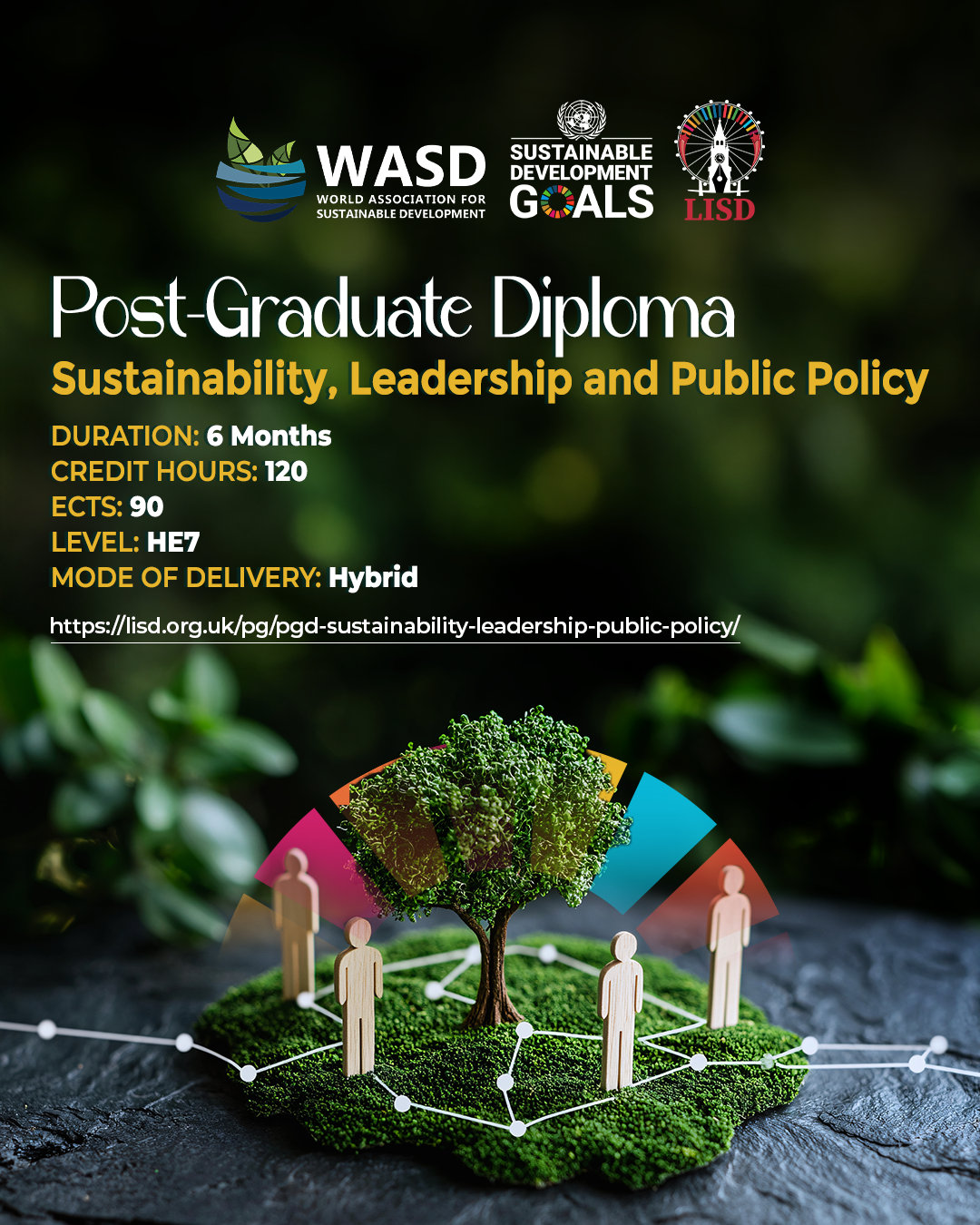
Post-Graduate Diploma Sustainability, Leadership and Public Policy

Duration: 6 Months
Credit Hours: 120
ECTS: 90
Level: HE7
Mode of Delivery: Hybrid (Online/Onsite on different locations across the world)

Overview

The Postgraduate Diploma (PGD) in Sustainability, Leadership and Public Policy at the London Institute of Sustainable Development (LISD) is a postgraduate programme designed to develop visionary leaders capable of driving sustainable transformation across sectors. Integrating the United Nations Sustainable Development Goals (SDGs 1–17) into every aspect of the curriculum, the programme combines rigorous business education with a deep understanding of environmental stewardship, ethical governance, and social equity.

Students gain advanced knowledge in sustainable management, strategic leadership, and evidence-based policymaking, with a focus on real-world applications that promote inclusive growth and responsible innovation. Through a blend of analytical, strategic, and leadership training, graduates are equipped to influence corporate and public sector decisions that align profitability with purpose. The programme empowers professionals to lead organizations and governments toward resilient, ethical, and sustainable futures in an increasingly interconnected global economy.

A One of-a-Kind Initiative

The Postgraduate Diploma in Sustainability, Leadership and Public Policy (PGD) at the London Institute of Sustainable Development (LISD) offers a distinctive and forward-looking learning experience designed for current and aspiring leaders in the public, private and third sectors. The programme integrates sustainability principles, ethical leadership and public policy practice into a coherent and applied learning journey.

Aligned with the United Nations 2030 Agenda and the Sustainable Development Goals (SDGs), the PGD enables students to critically engage with pressing global and societal challenges such as social equity, sustainable economic development, governance, climate action and public well-being. Students are encouraged to link theory with practice through policy-focused projects that address real-world issues.

The programme equips graduates with the analytical, strategic and leadership capabilities required to design, influence and implement effective public policies that promote sustainability, resilience and inclusive growth, preparing them to make meaningful contributions at local, national and global levels.
Related Sustainable Development Goals
  • SDG9
  • SDG17
  • SDG16
  • SDG15
  • SDG14
  • SDG13
  • SDG12
  • SDG11
  • SDG10
  • SDG4
  • SDG8
  • SDG7
  • SDG6
  • SDG1
  • SDG5
  • SDG2
  • SDG3
Related Courses
  • Post Graduate
Location

London Institute of Sustainable Development, London, United Kingdom
Get Directions
Country/Regions
  • Europe
  • UK
Social Networks
  • Facebook
  • Twitter
  • YouTube
  • LinkedIn
  • Website

Related Sustainable Development Goals
  • SDG9
  • SDG17
  • SDG16
  • SDG15
  • SDG14
  • SDG13
  • SDG12
  • SDG11
  • SDG10
  • SDG4
  • SDG8
  • SDG7
  • SDG6
  • SDG1
  • SDG5
  • SDG2
  • SDG3
Related Courses
  • Post Graduate
What will you learn

Learning Outcomes

  1. Apply Analytical and Evidence-Based Tools: Use quantitative, qualitative, and policy analysis methods to inform sustainable and strategic decision-making.
  2. Communicate with Impact: Produce clear, professional reports and presentations that meet academic, organisational, and policy standards.
  3. Integrate Interdisciplinary Knowledge: Connect business, governance, economics, and sustainability principles to practical leadership contexts.
  4. Advance Global and Societal Impact: Align strategies and solutions with the UN Sustainable Development Goals and ethical frameworks.
  5. Think Strategically and Innovatively: Apply critical and creative thinking to address complex sustainability and policy issues.
  6. Collaborate Effectively: Work in diverse teams, contribute to shared learning, and engage with professional and academic communities.
  7. Demonstrate Ethical and Responsible Leadership: Model integrity, accountability, and inclusivity in decision-making and public leadership.
  8. Drive Professional and Entrepreneurial Growth: Develop the skills, confidence, and vision for career advancement, policy influence, or sustainable enterprise creation.

Learning Outcomes for Knowledge & Understanding

  1. Demonstrate advanced knowledge of business, sustainability, leadership, and public policy.
  2. Understand global systems, governance, and the influence of socio-economic, political, and ethical factors on organisations and society.
  3. Apply management and policy frameworks to address complex sustainability and leadership challenges.
  4. Integrate principles of ethics, governance, and social responsibility into strategic and policy decisions.

Learning Outcomes for Cognitive, Intellectual or Thinking Skills

  1. Critically analyse global sustainability and policy issues using evidence-based reasoning.
  2. Apply strategic and innovative thinking to develop sustainable and inclusive solutions.
  3. Synthesise diverse information to inform responsible decision-making.
  4. Reflect critically on practice to enhance leadership effectiveness and lifelong learning.

Learning Outcomes for Practical, Professional or Subject-specific Skills

  1. Develop and implement strategies and action plans promoting sustainable development and organisational resilience.
  2. Communicate complex ideas effectively through professional reports and presentations.
  3. Apply leadership, negotiation, and stakeholder engagement skills in cross-sectoral contexts.

Learning Outcomes for Technical or Information Technology Skills

  1. Use analytical and digital tools (e.g., Excel, Python, Power BI, Tableau) for policy and sustainability analysis.
  2. Employ emerging technologies and data-driven insights for strategic and responsible innovation.
  3. Manage digital collaboration and communication effectively in professional and policy environments.
  4. Evaluate the role of technology and digital transformation in advancing sustainability and governance goals.

Learning Outcomes for Transferable, Key or Personal Skills

  1. Communicate clearly and persuasively across diverse and interdisciplinary settings.
  2. Collaborate effectively, demonstrating adaptability, empathy, and inclusive leadership.
  3. Exhibit self-awareness, resilience, and commitment to continuous professional growth.
  4. Demonstrate ethical awareness, social responsibility, and global citizenship in leadership and policy practice.
Programme Structure

Support for Student Learning

  • Academic Support: Tutorials, workshops, and one-on-one guidance help students develop subject knowledge, research skills, and assessment strategies.
  • Technical Support: Access to digital platforms, software, and resources supports learning, data analysis, and project development.
  • Personal and Professional Development: Career services, mentoring, and skills workshops enhance employability, leadership, and professional growth.
  • Inclusive Learning Environment: Support services are provided for diverse learning needs, including study skills, wellbeing, and accessibility accommodations.
  • Feedback & Continuous Improvement: Regular, constructive feedback on assessments fosters reflective learning and academic progression.

Programme Structure

The programme requires the successful completion of 120 credits at HE7, including a capstone project, for the award of the PGD Sustainability, Leadership and Public Policy. It equips professionals to lead effectively in a complex and rapidly evolving global environment, combining rigorous academic study with practical application, interdisciplinary learning, and a global perspective

Component Credits Hours
Module One:  Global Sustainability Challenges and Responses 30
Module Two: Digital Transformation and Organizational Excellence 30
Module Three: General Course Domains 30
Module Four: Transformative Leadership and Public Policy 30
Total Hours 180

Components of Modules

Module One:  Global Sustainability Challenges and Responses

  1. Principles of Sustainability and Sustainable Development
  2. United Nations and Sustainable Development
  3. Understanding the UN 2030 Agenda (17 SDGs, Targets, Indicators and Data and VNRs)
  4. Climate Change and Environmental Risk Management (Energy and Sustainability Policies)
  5. Critical Role of Healthcare in Achieving 2030 Agenda (Policies and Planning in Healthcare)
  6. Gender Equality for Sustainability (Policies for Women Empowerment)

Module Two: Digital Transformation and Organizational Excellence

  1. Digitisation and Digital Transformation (Technologies and Processes of DT and the Impact on SD)
  2. Knowledge Management (National Policies and Strategies for Knowledge-Based Economy)
  3. Artificial Intelligence (Role of AI to Achieve SDGs and Future Insights)
  4. Data Science (Science, Technology and Innovation Policy)

Module Three: General Course Domains

  1. Business and Economics
  2. Operations Management and Supply Chain
  3. Strategic Management and Planning
  4. Marketing Management

Module Four: Transformative Leadership and Public Policy

  1. Transformative Leadership
  2. Role of Women in Influential Leadership Positions
  3. Strategic Management and Planning
  4. Understanding Policy and Public Policy
  5. Policy Making Process (Problems Analysis and Setting the Agenda)
  6. Policy Implementation
  7. Managing Change and Transformation Process
Assessment

Assessment Strategy

The programme employs a diverse and integrated assessment strategy designed to evaluate knowledge, cognitive skills, practical competencies, and professional development. Assessment methods include:

  • Written assignments, essays, and research reports demonstrating critical analysis and subject mastery.
  • Project work, case studies, and capstone or applied research projects assessing practical problem-solving and application of theory.
  • Examinations and in-class tests to evaluate understanding of core concepts and analytical skills.
  • Presentations, portfolios, and reflective reports to assess communication, professional, and transferable skills.
  • Group and individual work to evaluate teamwork, leadership, and collaborative capabilities.

Assessment Regulations

  • Assessments are conducted in accordance with institutional policies, ensuring fairness, transparency, and academic integrity.
  • A combination of formative and summative assessments supports learning while providing opportunities for feedback and improvement.
  • Late submission, plagiarism, and academic misconduct are managed according to formal procedures and may impact progression or classification.
  • Students must meet minimum performance requirements across modules to achieve the overall award.

Grade Bands and Classifications

  • Final grades are awarded based on aggregated performance across assessments, using a percentage system at LISD.

LISD Grading System

Classification Percentage Range UK Grade GPA (approx.) Description
First Class Honours (1st) 70–100% A 4.0 Excellent / Outstanding
Upper Second Class Honours (2:1) 60–69% B+ / A– 3.3–3.7 Very Good
Lower Second Class Honours (2:2) 50–59% B / B– 2.7–3.0 Good
Third Class Honours (3rd) 40–49% C 2.0–2.3 Satisfactory
Fail Below 40% F 0.0–1.9 Fail / Unsatisfactory

🚀 View Past Participants
Target Participants

The PGD is a postgraduate degree that provides a comprehensive understanding of business management and leadership. It equips professionals with strategic, financial, and operational expertise to make informed decisions and lead effectively in a global context.

The PGD programme at London Institute of Sustainable Development (LISD) integrates UN Sustainable Development Goals (SDGs 1–17) into a business and leadership context, focusing on ethical decision-making, responsible innovation, and inclusive economic growth. Students explore areas such as sustainable finance, green entrepreneurship, corporate social responsibility, and global governance. The curriculum emphasizes on UN SDGs, equipping graduates to lead organizations toward profitability with purpose and resilience.

Contact Us
To register/enquire about this course and all our various comprehensive list of courses and workshops and if you have any question and/or if you would like to request a training workshop/program not listed in our portfolio please contact our Academic Director Professor Arshi Naim at: arshi@wasd.org.uk with a copy to admin@wasd.org.uk.

London Institute of Sustainable Development, London, United Kingdom

Get Directions
Registration and Fees

Included in the course fee, the following learning materials will be provided:

  1. Admission to all sessions.
  2. All overhead slides (PDF).
  3. Case studies (print and video).
  4. Full access to WASD Sustainability Library including all volumes of World Sustainable Development Outlook book series.
  5. Certificate of completion from WASD and LISD.

You May Also Be Interested In

Artificial Intelligence and Knowledge Management for Effective Leaders

Artificial Intelligence and Knowledge Management for Effective Leaders 18 Hours Course (Face to Face and…
  • Phone Number
  • SDG4
  • +3

Female Pelvic Medicine and Reconstructive Surgery (UROGYNAECOLOGY)

Female Pelvic Medicine and Reconstructive Surgery (UROGYNAECOLOGY)      REGISTER 48 Hours Course Friday…
  • Phone Number
  • SDG4
  • +4

Digital Transformation and Sustainable Development for Future Women Leaders

18 July 2023 This two-day course will be facilitated by world renowned experts in Digital Transformation…
  • Phone Number
  • SDG4
  • +2

The London Institute of Sustainable Development (LISD), founded under the auspices of the World Association for Sustainable Development (WASD), is a global centre committed to advancing the United Nations 2030 Agenda and its 17 Sustainable Development Goals (SDGs) through higher education, research, training, and consultancy.

Facebook-f Youtube Twitter Linkedin Flickr

Quick Links

  • About LISD
  • Gallery
  • Teams
  • Contact Us
  • Book Store

EXPERTS

  • Global Who’sWho
  • Women Who’sWho
  • Diaspora Who’sWho
  • Arab Who’sWho
  • Africa Who’sWho
  • Sudan Who’sWho

Get in touch

© LISD

All rights reserved

Cart

  • Facebook
  • Twitter
  • WhatsApp
  • Telegram
  • LinkedIn
  • Tumblr
  • VKontakte
  • Mail
  • Copy link