
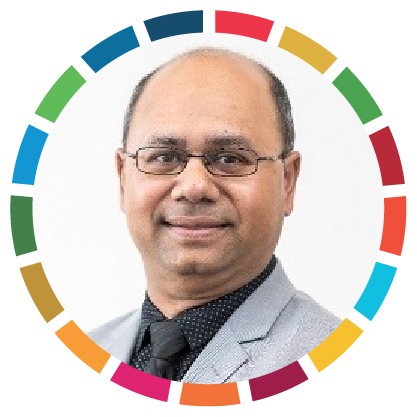
Professor Muhammad Aziz Rahman (Melbourne - Australia) is an experienced academic, a medical doctor and a public health professional. Following completion of medical graduation (MBBS), he completed his post-graduation in Public Health (MPH, PhD). Currently, he is working as the Associate Dean of Research at the Institute of Health and Wellbeing and the Professor of Public Health at Federation University Australia in Melbourne. Professor Rahman has been working in the areas of public health research and teaching for more than 20 years, both in Australian and international settings. He has an excellent track record of providing leadership in completing different research and community projects successfully, focusing on different aspects of public health, securing funding, producing high-quality research publications, supervising higher degree research students, assisting in capacity building and providing supportive supervision to the early/mid-career researchers and collaborating successfully with experienced researchers. Professor Rahman has published more than 200 research papers in multidisciplinary journals with more than 135,000 citations. Due to his extraordinary track record of research citations, he has been ranked amongst the world’s top 2% scientists for the last five years (2020-25), ranking done by Elsevier BV and Stanford University, USA. He has contributed to generating over $13 million in funding in his professional career. He has extensive international research collaborations with over 25 countries and has successfully led several multi-country research projects with significant outputs. Professor Rahman is also actively engaged with professional communities through different leadership roles. He is the Vice President at the Public Health Association of Australia (PHAA), the largest organisation for public health professionals in Australia.
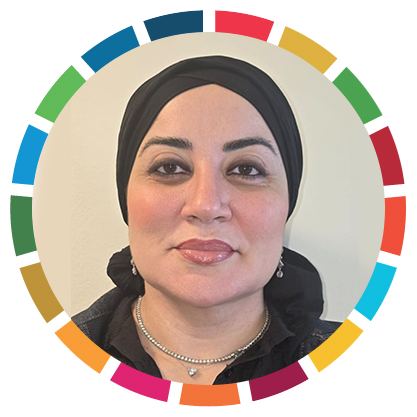
Dr Nisrine Slitine (Morocco) has always been attentive to the needs of the Moroccan society. As a doctor with a great entrepreneurial spirit, she quickly became aware of the importance of paramedical professions in the provision of health care at the national level, and the great deficit that the Kingdom knows in this matter. As a result, Dr Nisrine went into the business world, before supporting her doctoral thesis, and enrolled in the continuing education cycle of the Institut Supérieur de Commerce et d'Administration des Entreprises (ISCAE), a Business Management specialty, in order to equip itself with all the tools necessary to meet this crucial need that it has identified in the paramedic market.
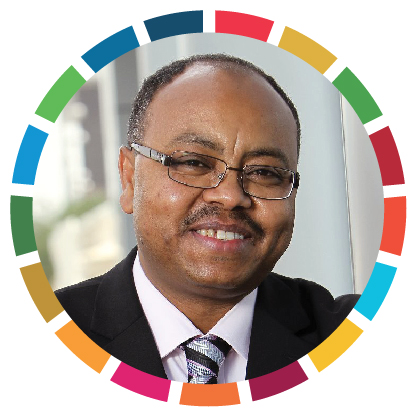
Professor Allam Ahmed (London - UK) is a Professor of Knowledge Management and Sustainable Development; Co-Founder of SMART KM MODEL: An Integrated Knowledge Management Framework for Organizational Excellence and led the implementation of the first of its kind in the Middle East and North Africa Knowledge Management Framework Musharaka. Founding President of WASD; SDGs Universities Initiative; Middle Eastern Knowledge Economy Institute; Fellow Faculty of Public Health, UK; Fellow Chartered Institute of Marketing, UK; and Fellow Academy of World Business, Marketing and Management Development, Australia. Prior to QMUL, Prof. Ahmed spent 15 years at the University of Sussex Science Policy Research Unit (1st science and policy think tank in the UK) where he established and led Sussex’s most successful postgraduate programme MSc International Management.
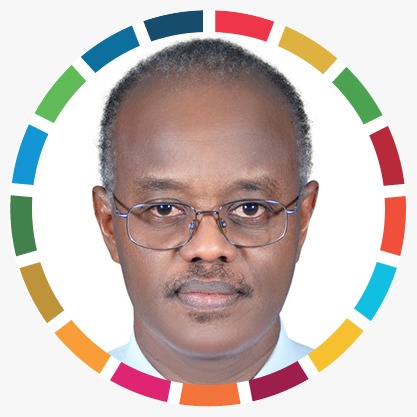 Dr Ibrahim Alfaki (UAE) is an Associate Professor of statistics in the Department of Statistics and Business Analytics at the United Arab Emirates University (UAEU). His research focuses on applied econometrics, spatial and statistical modeling, and data-driven policy analysis, with particular applications in road safety systems, economic and financial analytics, and the measurement of knowledge-based economies. His work emphasises the use of quantitative and data analytics methods, such as time series and econometric modeling, to support evidence-based decision-making and institutional performance evaluation. Professor Alfaki has contributed to national policy research, including the UAE Human Development Reports, in collaboration with government and international organizations. He has also served on the Scientific Committee of the Abu Dhabi Statistics Centre. In addition, he is a member of editorial advisory boards of several international journals, including WJEMSD, WJSTSD, and IJIKMMENA. His work reflects a sustained contribution to statistical applications in sustainable development and public policy.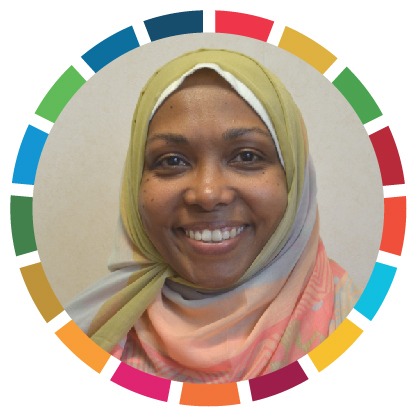
Dr Muna Abdel Aziz (Manchester - UK) is a Former Director of Public Health in the UK who now freelances as an Executive Coach and Mentor. She is a Fellow of the global Institute of Leadership, a Fellow of the Faculty of Public Health UK, and the International CPD Adviser for the Faculty. Muna continues to engage globally on initiatives that affect countries and regions with a special interest in maternal and child health, public health information systems, and mobile health. Re-elected by the UK Faculty of Public Health to the role of International CPD Adviser, and previously Training Programme Director for Public Health Specialty in Cheshire and Merseyside, Muna retains her passion for education and continuing professional development. She firmly believes that system leadership and multi-disciplinary working across sectors will be key to achieving the transformation needed to meet the sustainable development goals.
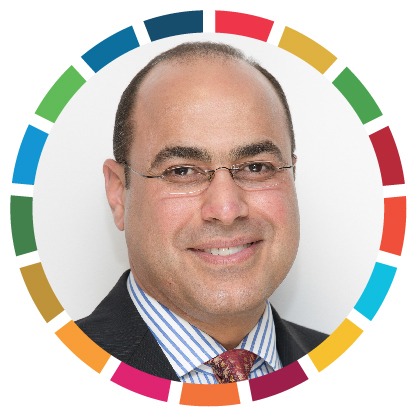
Dr Ihab Tewfik (London - UK) is a Registered Nutritionist and UNICEF-UN consultant with significant expertise in planning, implementing and evaluating sustainable public health nutrition intervention programmes at population level. Ihab has developed an independent research career that underpins the pivotal role of medical nutrition in regulating complications of chronic diseases through Tailored Functional Recipes (TFRs). These innovative TFRs are formulated, optimized using locally food ingredients and served as meals to nourish vulnerable populations to attain optimum health. The TFR-concept is not limited to elimination of malnutrition but extend to the design and engineering of food that transcends disease prevention by improving availability of micronutrients, increasing biological functions, and promoting sustainable health. Such concept has been employed to modulate global chronic disease in Georgia, Nigeria, Ghana, India, Lebanon, Nepal, Qatar, Kuwait and UK. Dr Tewfik has led the Human Nutrition degree at University of Westminster over the last twelve years as Programme Director. His research portfolio spans to investigate the relationship between obesogenic environment and health outcomes of individual and population. His work embraces the effects of nutritional exposure during childhood and risk factors for later non-communicable diseases (NAFLD, PCOs, ADHD, CVD, DM, Cancer) especially in countries experiencing nutritional transition. As Fellow of the Royal Society of Public Health (FRSPH), Ihab has been at the forefront of promoting global public health intervention with an international research agenda stretched to 11 research projects with UNICEF-UN in aspects of public health nutrition intervention. In UK, he has carried out three national projects on food safety (FSA-UK) and on Biomarkers for predicting breast radiotherapy induced side-effect funded by the National Cancer Research Institute.

Dr Mayada Abu Affan (UK) is the Interim Director of Public Health at Hammersmith and Fulham Council. She was the Former Director of Public Health and Wellbeing and Consultant in Public Health with Dudley Local Government leading on maternal and child health, reproductive health, healthy ageing and the lead for Public Heath training and workforce development. She graduated from Khartoum Medical School in the Sudan, completed foundation training and the MD in Obstetrics and Gynaecology in the Sudan. During her working in obstetrics and gynaecology she became convinced that a combination of population and clinical perspectives are the most powerful approaches to improving health and achieving a bigger impact on health and health service quality, as a resulted she entered the Public Health higher specialist training programme in Scotland and obtained the Certificate of Completion of Training (CCT) in 2006. Following the attainment of the membership of the Faculty of Sexual and Reproductive Healthcare in 2009, she became one of few people who are dually accredited in Public Health and Sexual and Reproductive Health in the UK. She also works as a community gynaecologist on part time bases and as an honorary lecturer at the University of Birmingham. She has worked in different systems and diverse settings in the England, Scotland, the Sudan and Uppsala in Sweden. This has given her the opportunity to experience the impact of culture, resources and political stability on population health. She is passionate about effective system leadership and its impact on developing health systems. In recognition of the importance of effective leadership in developing countries, she co-authored a leadership course for developing countries. The course focuses on System Leadership and addresses challenges facing effective leadership in developing countries such as resource constraints and lack of political engagement. She has been taking part in teaching this course, with colleagues in the Sudan, for the past five years.