• ABOUT
    arrow_drop_down
    • Overview
    • Director’s Message
    • Team
    • Contact Us
  • Teaching
    arrow_drop_down
    • Overview
      arrow_drop_down
      • Framework
      • Pedagogy
    • Universities
      arrow_drop_down
      • SDGs Universities
      • African Universities
        arrow_drop_down
        • Sudan Universities
      • Arab Universities
        arrow_drop_down
        • Gulf Universities
          arrow_drop_down
          • Qatar Universities
          • Bahrain Universities
          • Kuwait Universities
          • Emirates Universities
          • Oman Universities
          • KSA Universities
      • Islamic Universities
      • Women Universities
    • Programmes
      arrow_drop_down
      • PhD/DBA
      • MSc/MBA
      • PG Diploma
      • PG Certificate
    • Courses
    • Faculty
    • Admisison
      arrow_drop_down
      • Fee Structure
        arrow_drop_down
        • Postgraduate Diploma
        • MBA/MSc
      • Scholarship
  • Research
  • Consultancy
    arrow_drop_down
    • Experts By Subject
      arrow_drop_down
      • Sustainable Development
        arrow_drop_down
        • Sustainable Development Goals
        • Voluntary National Reviews
        • Climate Change
      • Higher Education
        arrow_drop_down
        • E-Learning
      • Digitalisation
        arrow_drop_down
        • Digital Transformation
        • Artificial Intelligence
        • Knowledge Management
          arrow_drop_down
          • Smart KM
      • Health and Wellbeing
        arrow_drop_down
        • Healthcare Leadership
        • Public Health
        • Diagnostic Radiology
      • Policy and Strategy
        arrow_drop_down
        • Public Policy
      • Business and Management
        arrow_drop_down
        • Marketing
    • Who’sWho Network
      arrow_drop_down
      • Global Who’sWho
        arrow_drop_down
        • Join
      • Women Who’sWho
      • Diaspora Who’sWho
      • Arab Who’sWho
      • Africa Who’sWho
      • Sudan Who’sWho
        arrow_drop_down
        • Doctors
    • Interactive Map
      arrow_drop_down
      • Global
      • Arab
      • African
      • Sudan
        arrow_drop_down
        • Doctors
      • Women
  • Training
    arrow_drop_down
    • Overview
    • Search All
      arrow_drop_down
      • Forthcoming
      • Past
      • Search by Levels
        arrow_drop_down
        • Diploma
        • Programmes
        • Courses
      • Search By Subject
        arrow_drop_down
        • Sustainability Masterclass
          arrow_drop_down
          • Economy
          • Sustainability
        • Public Policy
          arrow_drop_down
          • Public Policy
          • Education
          • Higher Education
          • Health
            arrow_drop_down
            • Covid-19
          • Women
          • Youth
            arrow_drop_down
            • Security
        • Digital Transformation
          arrow_drop_down
          • Artificial Intelligence
          • Data Science
          • Digital Transformation
          • Innovation
          • Knowledge Management
          • Technology Transfer
        • Business & Management
          arrow_drop_down
          • Entrepreneurship
          • HRM
          • Leadership
          • Management
          • Performance Improvement
          • Investment
    • Workshops
    • Programmes
  • Partnerships
  • Resources
    arrow_drop_down
    • Videos
    • Books
    • Digital Library
    • Book Store
  • Media
    arrow_drop_down
    • Videos
    • Gallery
  • Latest News
  • FAQs
Sign in or Register

Data Science and Analytics for Food Security

  • Send an email
  • Other Courses
  • Overview
  • Support
  • Learning Outcome
  • Programme
  • Assessment
  • Resources
  • Target Participants
  • Faculty
  • Registration
  • Gallery
  • Books
  • prev
  • next
  • Get directions
  • Other Courses
  • Share
  • prev
  • next
Overview

Summer School in Data Science & Analytics for Food Security (51 Hrs)

THREE WEEKS COURSE      

August 2024
ICESCO HQ and AOAD Digital Knowledge Hub, Rabat - Morocco 

Part One (Pre-course online) 7 Days (21 Hours)
Part Two (Face-to-face training) 5 Days (25 Hours)
Part Three (Post-course online) 5 Days (15 Hours)

The workshop will be facilitated two of the world-renowned experts in Digital Transformation, Dr Rawad Hammad and Professor Allam Ahmed winners of Emerald Literati Award for Outstanding Paper 2021 on learning theories and models underpinning technology-enhanced learning artefacts.

Food Security is gaining an enormous interest since COVID Pandemic and Ukraine-Russa conflict. Supporting planning and decision making for food security is now on the top agenda of states and international organizations. This workshop has been designed to introduce a variety of fundamental perspectives on Digital Transformation (DT), Artificial Intelligence (AI), Data Science (DS) and Knowledge Management (KM) to support a more intelligent and comprehensive planning and decision support in many aspects.

The aim of this course is to develop an upgraded critical mass of experts and policy makers cross the Arab world that can use these smart tools applied to food security planning and decision support. This introductory course aims at providing students with insights on how data-related methods are used to tackle and monitor food security. It gives an overview of a data science based approach.

The program uses a blended approach of teaching, where digital and physical presence were used. A pre workshop one-week online module prepares the audience with fundamentals followed by an intensive face to face one week workshop where core learning activities will be conducted through instructor’s lectures and invited seminars by experts. A practical module accompanying the theoretical component with hands-on sessions with Python notebooks will also be planned. The Python module will give students the opportunity to put into practice the methods introduced during the course through the exploration of AOAD open datasets and research question (e.g., estimating Food Deficits from Agricultural data).

The course objective is to upgrade a critical mass of Arab Policy Makers and Experts in modern smart approaches in food security modelling.
Related Sustainable Development Goals
  • SDG4
  • SDG8
  • SDG9
  • SDG1
  • SDG2
Related Courses
  • HRM
  • Sustainability Masterclass
  • Leadership
  • Performance Improvement
  • Public Policy
  • Artificial Intelligence
  • Data Science
  • Knowledge Management
  • Technology Transfer
  • Digital Transformation
  • Management
  • Innovation
  • Entrepreneurship
  • Economy
Location

Rabat, Rabat-Salé-Kénitra, Morocco
Get Directions
Country/Regions
  • Morocco
  • MENA
  • Africa
Social Networks
  • Facebook
  • Twitter
  • YouTube
  • LinkedIn
  • Website
Related Sustainable Development Goals
  • SDG4
  • SDG8
  • SDG9
  • SDG1
  • SDG2
Related Courses
  • past
What will you learn
  • Developing familiarity with Food Security models and its related data science applications.
  • Gaining an in-depth knowledge and applied data science skills about food security planning and decision support.
  • Understanding the potential of AI, KM and data science on your organisation/career in terms of productivity.
  • Understand the difference between AI, machine learning and deep learning.
  • It is a great opportunity for participants to gain good knowledge on AI and data science and gain background information on problem solving using AI. Moreover, you will also learn about problem description, representation and solving using AI and/or data science.
Benefits for Employers
  1. Meeting with other participants and enhance relationship with different organizations.
  2. The opportunity for employers to showcase their role in different field.
  3. At the end of the course attendees should be able to acquire a comprehensive knowledge and practical experience about AI n alignment with the local needs and capabilities.
  4. This course will also complement the different management skills already developed through earlier courses.
  5. Addresses the practical challenges that managers face as they seek to build, upgrade and exploit knowledge assets within their organizations
  6. Debate the importance and value of managing knowledge within your organization
  7. Using participants’ own organizations as cases, participants will explore how and when they can establish AI initiatives in their organizations and who will be involved?
  8. Moreover, after competition of the course, participants to write a report, supported by the tutor, of what they have learnt and what is particularly relevant to their employers. A focus to be one aspect of the workshop which has implications for the way they will improve their professional practice when they return to their employers. This will help reassure the employers of the benefits of the programme and help consolidate the understanding of the manager.
Programme Structure
  1. For each session there is an activity or set of activities. These are designed to help you engage with the introduction to the theories explored within the course.
  2. Your tutor will be on hand to guide you through the course and will expect you to bring to bear personal experience and reflection on the topics covered.
  3. Group work will be required for participants to engage in the workshop. Such activity allows participants to embed the new.
  4. knowledge within their experience through active discussion and challenge.

COURSE CONTENTS:

  • Agricultural Statistics Fundamentals (Descriptive Statistics, Sampling, Hypothesis Testing, Errors and Estimation, Qualified Assessment)
  • Python for Data Science
  • Agricultural and Food Security Data Repositories
  • From Data Banks to Data Spaces
  • Big Data in Agriculture and Food Trade
  • Spatial Data and GIS concepts
  • Food Security Models and Indicators
  • Forecasting, Data Mining, and Intelligence
  • Artificial intelligence & Machine Learning
  • High Performance Computing
  • Visualization and Presentation
Programme Day One

Monday 
08:45 - 09:00
Arrival refreshment and networking

09:00 - 10:30
Session (1) Introduction 

  • Introduction to the course and the organisation.
  • Challenges facing leaders in the post Covid-19 era.
  • Organisation transformation in the 21st Century.

10:30 - 11:00 Tea/Coffee Break and Networking

11:00 - 12:30
Session (2) Effective Change Management and Strategic Alignment 

  • Change Management.
  • Strategic Leadership.
  • Impact Analysis.

12:30 - 13:30 Lunch Break and Networking

13:30 - 15:00 

Session (3) KM and Leadership Group Exercise (3 - 5 trainees in each group)

  • What is leadership?
  • KM spotlighting best documents.
  • KM pre-proposal organisation assessment.
  • Conclusion, presentation and discussion.

END OF DAY ONE 

Programme Day Two

Tuesday 
08:45 - 09:00
Arrival refreshment, reflection on Day 1 and networking

09:00 - 10:30

Session (4) Understanding Digital Transformation

  • DT foundations and pillars.
  • DT frameworks.
  • Innovation and business models in the context of DT.

10:30 - 11:00 Tea/Coffee Break and Networking

11:00 - 12:30

Session (5) Digital Transformation Analysis

  • DT readiness assessment for your organisation.
  • DT strategies, technologies and processes.
  • Research Hubs for DT, AI and organisational excellence.

12:30 - 13:30 Lunch Break and Networking

13:30 - 15:00 
Session (6) Digital Transformation Brainstorming Group Exercise (3 - 5 trainees in each group)

  • Pick up a strategy/plan for any of your organisations.
  • Analyse the progress in the plan.
  • Identify the pain points according to your knowledge.
  • Suggest how Digital Transformation can be used to resolve the early-identified pain points.
  • Conclusion, presentation and discussion.

END OF DAY TWO 

Programme Day Three

Wednesday 
08:45 - 09:00
Arrival refreshment, reflection on Day 2 and networking

09:00 - 10:30

Session (7) Knowledge Management 

  • What is KM?
  • Understanding KM within organisations.
  • KM case studies.

10:30 - 11:00 Tea/Coffee Break and Networking

11:00 - 12:30

Session (8) KM Framework

  • KM readiness assessment for your organization.
  • SMART KM Model.
  • Establishment of KM Community of Practice (CoP) in your organization.

12:30 - 13:30 Lunch Break and Networking

13:30 - 17:00 
Session (9) Study Visit (more details to follow)

END OF DAY THREE 

Programme Day Four

Thursday 
08:45 - 09:00
Arrival refreshment, reflection on Day 3 and networking

09:00 - 10:30

Session (10) Artificial Intelligence for Business Excellence

  • Understanding AI.
  • Implementation of AI in business context.
  • Data science for managers and leaders.

10:30 - 11:00 Tea/Coffee Break and Networking

11:00 - 12:30

Session (11) Learning Strategies 

  • Data analytics and decision support system.
  • Deep learning.
  • Machine learning.

12:30 - 13:30 Lunch Break and Networking

13:30 - 15:00 
Session (12) Digital Transformation Risk Management Group Exercise (3 - 5 trainees in each group)

  • Select one of the early-developed Digital Transformation strategies/plans.
  • Align it with one of your organisational strategy.
  • Analyse the risk associated with applying the proposed DT plan.
  • Propose few risk mitigation strategies.
  • Conclusion, presentation and discussion.

END OF DAY FOUR  

Programme Day Five

Friday 
08:45 - 09:00
Arrival refreshment, reflection on Day 4 and networking

09:00 - 10:30

Session (13) Digital Transformation Strategy 

  • DT strategy formation and performance management.
  • Develop a data strategy.
  • Future perspectives for DT.

10:30 - 11:00 Tea/Coffee Break and Networking

11:00 - 12:30

Session (14) Knowledge Management Strategy 

  • KM and strategic management and alignment.
  • Evaluate the benefits of carefully thought through KM strategies.
  • Transformative leadership.

12:30 - 13:30 Lunch Break and Networking

13:30 - 14:30 
Session (15) Conclusion and Graduation

  • Concluding remarks and next steps.
  • Presentation of Certificates.

END OF PROGRAMME 

Target Participants

The course covers materials for all levels from supervisory through to senior level from the Arab States institutes working in Food Security. Participants will be assessed on three elements:

  • Individual participation in class (20%)
  • A Review report and presentation about one of the covered topics (20%)
  • Online test (20%)
  • Final project 40%)

Dr. Rawad Hammad
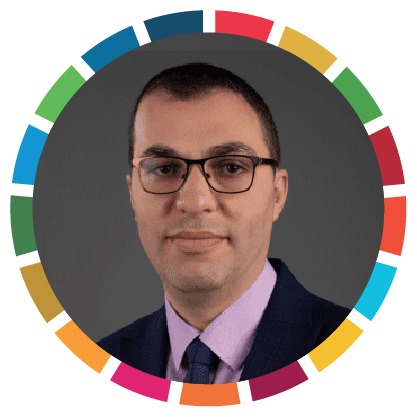
Rawad is a computer scientist with 20 years of experience in academic research, teaching, industry and leadership. He is a Senior Lecturer in Computer Science and Digital Technologies and the leader of two MSc Programmes and a Technology-Enhanced Learning Research Group at the University of East London.  He is also co-director and co-founder of a newly established Smart Health Centre at UEL. He is an executive committee member of the international society of Artificial Intelligence in Education, and a panel member of different research journal/conference communities such as EC-TEL, IARIA, WASD.

Professor Allam Ahmed
Professor of Knowledge Management and Sustainable Development; Co-Founder of SMART KM MODEL: An Integrated Knowledge Management Framework for Organizational Excellence and led the implementation of the first of its kind in the Middle East and North Africa (MENA) Knowledge Management Framework (KMF) Musharaka. Founding President of World Association for Sustainable Development (WASD); Founding Director of SDGs Universities International Initiative (SDGsUNI); Founding Director of Middle Eastern Knowledge Economy Institute (MEKEI); Founder, in collaboration with the UNESCO Chair on Transfer of Technology (UNESCOTT), the International Diaspora Initiative/Sudan Knowledge (SK). Fellow Faculty of Public Health (FPH), UK; Fellow Chartered Institute of Marketing (CIM), UK; and Fellow (FAWB) Academy of World Business, Marketing and Management Development (AWBMMD) Australia. Professor Ahmed spent 15 years (2004-2019) at the University of Sussex Science Policy Research Unit (SPRU) (1st science and policy think tank in the UK) where he established and led Sussex’s most successful postgraduate programme MSc International Management.

Contact Us
To register/enquire about this course and all our various comprehensive list of courses and workshops and if you have any question and/or if you would like to request a training workshop/program not listed in our portfolio please contact our Academic Director Professor Arshi Naim at: arshi@wasd.org.uk with a copy to admin@wasd.org.uk.

Rabat, Rabat-Salé-Kénitra, Morocco

Get Directions
Registration and Fees

Included in the course fee, the following learning materials will be provided:

  1. Admission to all sessions including all coffee/tea breaks and lunches.
  2. All overhead slides.
  3. Case studies (print and video).
  4. Certificate of competition from Queen Mary University of London and WASD.

You May Also Be Interested In

Artificial Intelligence and Knowledge Management for Effective Leaders

Artificial Intelligence and Knowledge Management for Effective Leaders 18 Hours Course (Face to Face and…
  • Phone Number
  • SDG4
  • +3

Female Pelvic Medicine and Reconstructive Surgery (UROGYNAECOLOGY)

Female Pelvic Medicine and Reconstructive Surgery (UROGYNAECOLOGY)      REGISTER 48 Hours Course Friday…
  • Phone Number
  • SDG4
  • +4

Digital Transformation and Sustainable Development for Future Women Leaders

18 July 2023 This two-day course will be facilitated by world renowned experts in Digital Transformation…
  • Phone Number
  • SDG4
  • +2

LISD, founded under the auspices of WASD, is a global centre committed to advancing the UN 2030 Agenda and its 17 SDGs through higher education, research, training, and consultancy.

Facebook-f Youtube Twitter Linkedin Flickr

Quick Links

  • About LISD
  • Gallery
  • Teams
  • Contact Us
  • Book Store

Programmes

  • Healthcare Leadership
  • Leadership and Public Policy
  • Islamic Fintech
  • Obstetric and Gynaecological Ultrasound
  • Digitalisation
  • Women Leadership

Get in touch

© LISD

All rights reserved

Cart

  • Facebook
  • Twitter
  • WhatsApp
  • Telegram
  • LinkedIn
  • Tumblr
  • VKontakte
  • Mail
  • Copy link